
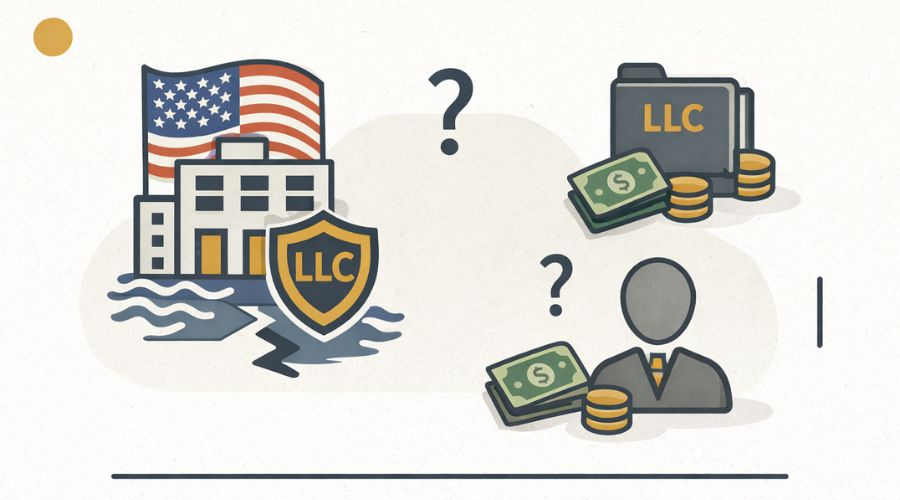
When a non-U.S. entrepreneur expands into the United States, the entity most commonly chosen is the Limited Liability Company – LLC. It is quick to form, flexible, and relatively inexpensive.
The problem is that it is almost always perceived as the “American limited liability company equivalent” of a domestic corporation. From a tax perspective, that assumption is incorrect.
An LLC is not a tax status. It is only a legal wrapper: taxation depends entirely on how the entity is classified for tax purposes.
In practical terms, forming an LLC is not selecting a company — it is selecting who the taxpayer will be.
The core principle: the U.S. taxes taxpayers, not legal vehicles
In many jurisdictions, the legal entity exists first and taxation follows. The U.S. system works differently: the tax system first determines the taxpayer, and only then the applicable tax regime.
For federal tax purposes, an LLC may be treated as:
- a disregarded entity
- a partnership
- a corporation (via election)
This is known as entity classification (the “check-the-box” rules). The legal entity does not change – the taxpayer does.
Pass-through LLC: the entity does not pay tax, the owners do
If no corporate election is made, the LLC is fiscally transparent.
The entity itself does not pay income tax. Income is allocated directly to the members. This leads to a frequent surprise for foreign founders: tax is due even if no cash distribution is made.
The LLC files an informational return (Form 1065) and issues a Schedule K-1 to each member.
At that point, the income becomes personal taxable income.
For a non-U.S. owner, a significant consequence arises: the owner becomes a U.S. taxpayer.
The individual must file Form 1040-NR and pay tax on income effectively connected with the U.S. business (ECI). This is not dividend taxation; it is direct personal taxation in the United States.
LLC taxed as a corporation: the entity becomes the taxpayer
An LLC may elect corporate taxation.
In that case, the entity becomes a separate taxpayer: it files Form 1120 and pays U.S. federal corporate income tax at 21%.
Only when profits are distributed to the foreign shareholder does withholding tax apply (generally reduced under applicable convention for the avoidance of double taxation).
The logic changes entirely:
- income allocation is irrelevant
- actual distributions trigger taxation
The owner is no longer treated as operating in the U.S., but as a foreign investor in a U.S. company.
The 21% rate is not the real tax burden
The U.S. corporate tax rate is often cited as 21%. This is accurate but incomplete. The United States operates a layered tax system:
- federal taxation;
- state taxation;
- sometimes local taxation.
For example, a company operating in Florida generally bears approximately: 21% federal tax and (after 2022/1/1) 5.5% state corporate tax.
The practical corporate tax burden is therefore roughly 26–27% before dividend distributions. For a pass-through LLC, by contrast, the tax burden shifts directly to the owner rather than remaining at entity level.
The decision is not about the lowest rate
Many founders try to choose the structure with the lowest tax rate. That is rarely the correct approach. The relevant considerations are structural:
- will profits be distributed or reinvested?
- will the owner work physically in the U.S.?
- will investors enter the company?
- is a future exit planned?
An LLC does not itself determine a tax regime: the tax classification of the entity establishes the taxpayer and the manner of taxation. Absent prior planning, the default U.S. classification rules apply automatically, often producing unintended tax consequences.